

Greetings my fellow humans on the internet. I’ve come to you in text form to talk about some of my favorite underrated films of 2026 so far. Granted, we are half into the year and there’s been a bunch of great, small gems that I would like to highlight here on the site. If you want a deeper critical consensus on what I think about the listed films here, please check out my YouTube video on it. Otherwise here we go!
VIDEO
Corey Feldman vs. the World

Corey Feldman has been living in hell ever since his mentor, Michael Jackson, died in 2009.
Quite frankly, Feldman is one of the most innovative voices in outsider music today. Albums like Angelic 2 the Core and Love Left 2: Arm Me with Love search for the truth behind the madness of being a full-grown adult. This documentary captures the rage and sadness that now define Feldman’s character. He comes across as bitter, jaded, and egotistical to the core (or Angelic core), all while seemingly enslaving several women against their will as part of his demonic musical acts. The film bluntly presents Feldman as a martyr, even a savior of pop music, despite the increasingly unsettling reality unfolding around him. Feldman is still haunted by what he alleges Hollywood elites did to him physically and mentally as a child. That trauma appears to transfer onto the women portrayed in this documentary, making it shockingly depressing to watch what’s at stake during this chapter of Feldman’s life and career. At the same time, it’s also extremely, and unintentionally, hilarious in more than a few spots.
If you’re looking to catch up on Corey Feldman’s life, this documentary might do the trick.
Videoheaven

This felt like an F.D. Signifier YouTube video through and through. It’s a nearly three-hour documentary that deep-dives into every cultural aspect of the video store, from its inception all the way to its inevitable demise, largely caused by the enshittification of media ownership and the unfortunate cultural shifts in how we consume and talk about media as a society.
Video stores used to be a communal experience where families and cinephiles could come together to pick out films based solely on their expressive cover art or the loglines printed on the back of VHS tapes. There was something magical about discovering a movie that way, long before algorithms decided what was worth your own attention.
This documentary isn’t afraid to explore the darker side of the video store art form, either. At the same time, it serves as a time capsule for what once was and everything we’ve lost along the way.
OBLIGATORY, FUCK STREAMING!! LONG LIVE PHYSICAL MEDIA!!!
Levitating

Wregas Bhanuteja has been on my radar ever since Andragogy in 2024. His latest film feels like a mixture of Sirât, Linda Linda Linda, and No Other Choice. It follows a young man on the verge of being evicted from his home who, out of sheer desperation, joins his town’s Trance Dance Club.
The club performs ritualistic dances to the sound of flutes and drums in an attempt to conjure spirits, believing the ceremonies can save them from their misery. The young man quickly becomes consumed by these spiritual rituals, to the point where he’s eventually possessed and the townspeople as well. He simply has NO OTHER CHOICE but to do what he needs to do to get his home and life back on track.
Bhanuteja uses song and dance to summon holy spirits from within every character. It’s wretched in its spirituality and breathtaking in its guttural effect on the audience. This is absolutely the kind of film that deserves to be cranked up on a Dolby Atmos speaker system while high on LSD.
Carolina Caroline

Carolina Caroline feels like an outlaw country love song visualized in Technicolor.
Two outlaws fall in love and do crime shit. That’s basically the entire film, and it’s glorious. Samara Weaving plays the hot blonde who dances to Chris Stapleton, eats hot chips, and sometimes lies through her teeth. Meanwhile, Kyle Gallner gives his best performance to date as the charming criminal who takes Caroline (Samara Weaving) under his wing and shows her the ropes of pulling off crime while making every second of it feel worthwhile.
Adam Rehmeier continues building a relationship with classical cinematic techniques through the use of 16-35mm cinematography, luscious production design, and deeply relatable characters. Just like Snack Shack and Dinner in America, Rehmeier has a great eye for America and what it really is. That alone makes this film worth checking out.
Romería

Carla Simón’s follow-up to Alcarràs has a dreamy travelogue aesthetic that complements its naturalistic approach. A young woman tries to piece together her life after her father seemingly disappeared out of thin air. She’s forced to use her own eyes to understand the intricacies of abandonment. Simón chooses to follow the main character through drifting chapters. It’s even more heartbreaking to learn that Marina’s (Llúcia Garcia) father died during the AIDS crisis. The stigma surrounding it isn’t addressed head-on until Marina finally chooses to let herself go.
Romería showcases Simón’s ability to let a story unfold with patience. She has certainly stepped up her game since her last two films, and I’m excited to see what she does next in her career.
Buffet Infinity

Remember Too Many Cooks? Remember how surreal it was? Now think about that short and how fucking crazy its concept was. Buffet Infinity basically takes that idea and pushes it even further into an allegorical expression of the evils of capitalism and competitiveness within the food industry.
Shot entirely as if you’re watching TV commercial after TV commercial, the film follows two restaurants competing for attention and ad space in a small Canadian town. Their rivalry spirals into a level of competitiveness that breeds into violence and rage towards other businesses that aren’t even part of the food industry.
A strip mall has a sinkhole in its parking lot. The next wave of TV spots and news reports shows the hole growing bigger and meaner. Then all of the businesses start talking smack about the new buffet restaurant. Soon after, one of the restaurant’s key employees allegedly disappears. And that’s just some of the craziness that happens in the film. I can’t nearly describe this film to someone who hasn’t been apart of the food industry. In fact, it pukes out the feeling of never being apart of this certain type of business ever again in the long-run.
Buffet Infinity is hilarious, incredibly strange, and mesmerizing. This is easily one of the creepiest and surrealist films you’ll see this year.
Josephine

A young girl witnesses an assault in the park and is left trying to unpack what she saw. Shot entirely from Josephine’s point of view, Josephine is unafraid to explore the guarded trauma and terror of living with that certain secret forever.
Mason Reeves delivers one of the best child performances of the decade so far as Josephine. She plays the character like a normal child, but with a hidden sadness that lingers in her facial expressions and body language. Channing Tatum plays the father who will do anything to protect his child, even after learning what happened in the park.
The voyeuristic realism is something Beth de Araújo explored in her debut, Soft & Quiet. However, this time it serves a greater purpose, showing the other side of the story through the way children see things that adults often miss. Josephine no longer feels like a child. She doesn’t feel like the other girls now that her life has changed. That’s something our modern society needs to confront head one. Especially victims of abuse who don’t know where to start when the conversation needs to be had and handled with care.
Yes, the film is heavy with heart and soul, but that’s what indie filmmaking should be. It should provoke. It should ask questions about the morality of its characters’ motivations. And it should, in fact, spark a bit of well-rounded controversy (unlike Citizen Vigilante…)
Silent Friend

Silent Friend uses plants as a gateway into the human mind. Tony Leung plays a professor who wants to study how plants function within the fortification of our minds. A giant tree stands in the backyard of the university campus, and it begins to telepathically reveal several vignettes from people’s lives across different decades.
One branch follows a young German woman who wants to feel seen within the catacombs of a masculine world. Another centers on a young German man who’s forced to care for his lover’s plants. The older professor in the present day is somehow telepathically guiding these German students from the early 1900s and the 1970s to embrace freedom and trust their intuition. The audience has to surrender to that idea through and through. And while yes, it’s very esoteric in it’s presentation, there is somehow an earnesty attached to all the characters.
Even without fully understanding the confines of botany and dendrology, there’s an immense energy flowing through every character in the film. I really had to sit with the tenderness and stillness of each frame, each one feeling like a moving painting. There’s also a calmness to Tony Leung’s performance that I couldn’t take my eyes off. By the end of the film, his character begins to understand the true power of nature and stillness.
Departures

Two blokes by the name of Benji (Lloyd Eyre-Morgan) and Jake (David Tag) come together on a trip to Amsterdam and strike up an arrangement with each other. Over the course of the film, both characters grapple with their growing horniness and attraction toward one another.
Departures is a painfully accurate portrayal of how hookups can evolve when you spend enough time together. It might not make sense to some straight people, but there are times when you’ll hang out with a hookup for a weekend or two and suddenly start catching feelings. Then the nostalgic flashbacks begin to spiral as those hookups become a routine part of your life.
The film takes no prisoners in showing how these characters are driven by their own instincts and competitiveness with each other. It’s blunt and egotistical to its core, and it might rustle some jimmies with the way it portrays hookup culture within the LGBTQ community. But I really fucked with it (literally).
Two Seasons, Two Strangers
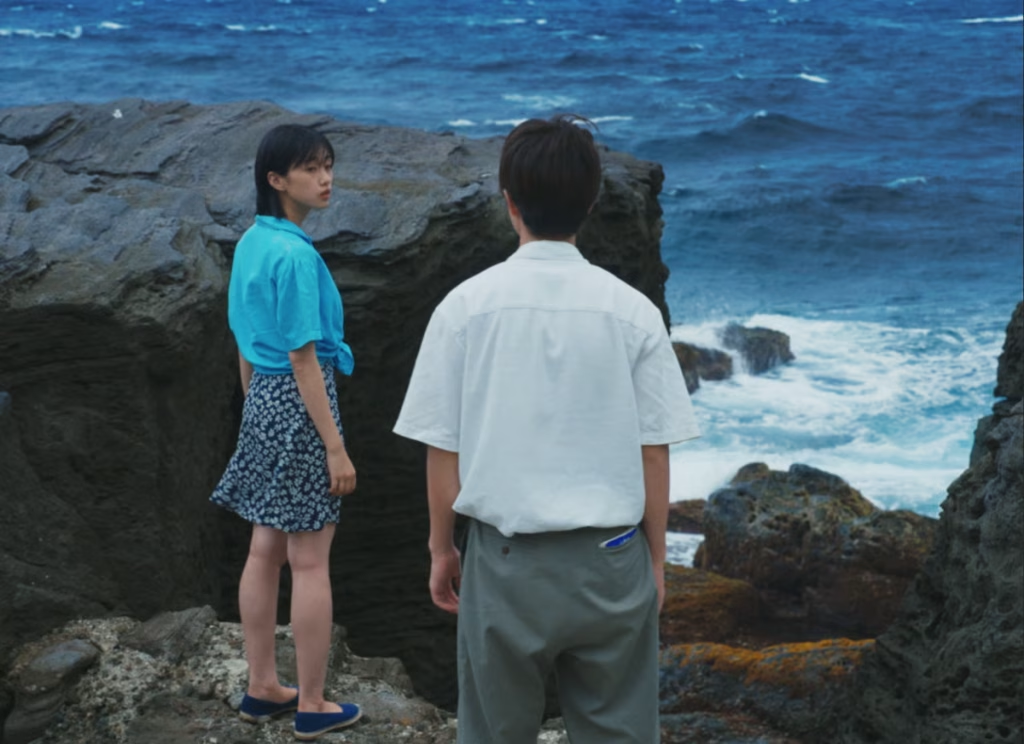
The title is exactly what you get. Two strangers fall in love in a beach town in Japan. A series of intimate conversations unfolds as the narrator turns the story into reality. Every character in the film is stumbling through their fractured ideas of love and romance while also being enamored by their own individual realities.
Éric Rohmer’s influence is subtly present throughout the film. It’s basically the Japanese version of A Summer’s Tale, but with a metafictional twist. At the same time, the film feels nostalgic because of the characters’ yearning for love. Love for their art, and love for their own sensibilities.
Mile End Kicks

Mile End Kicks is very entertained by the nostalgic era of 2010s indie sleaze. During this time, acts like Deerhunter, Arcade Fire, and The National showcased messy and diaristic messaging about the state of the world following the aftermath of the 2008 financial crash.
Grace Pine (Barbie Ferreira) is an independent music journalist who embarks on an adventure to Montreal to write a biography about Alanis Morissette’s album Jagged Little Pill. This monumental album reflects Grace’s inability to express herself as an individual and as a writer who dabbles in music criticism. The constant tug and pull between these identities is juxtaposed with the film’s portrayal of everyday coming-of-age tropes. While this is your typical coming-of-age story where the main character moves to an unknown city, only to learn about their new instincts when they meet a new friend group, the backdrop of the underground music scene in 2011 Montreal is something worthwhile to cherish. Especially now in days where algorithms dictate music tastes as a whole.
In fact, indie music back then was such a monumental pastime, nostalgically speaking. Music websites like Pitchfork and Stereogum relished in the notion of showcasing underground acts on their websites. And Grace is trying her hardest to become more individualistic with her writing. I can certainly relate to Grace, especially when I was in my early 20s trying to find my own voice in my career and in my hobbies. Barbie Ferreira continues to impress me as an actress, and I’m glad she broke free from the reins of Sam Levinson (Euphoria).
Tuner

Tuner is a nice throwback to 1970s crime aesthetics as you follow a piano tuner and his downfall into crime. Niki White (Leo Woodall) has hyperacusis and can’t play the piano anymore. His tuning days are the only thing he has left to live for. When a few Israeli safe crackers show up at Niki’s job site, his temptation to enter the safe-cracking industry starts to blossom. Even more so, the reason behind his turn to crime comes from Harry Horowitz’s (Dustin Hoffman) impending demise. Harry is on his deathbed, and it’s up to Niki to save him from America’s aggressive healthcare system.
Daniel Roher brings forth every crime trope into the forefront while being earnest about the characters’ motivations and feelings toward each other. Even when the wrong paths start to crash into Niki’s lifestyle. Leo Woodall solidifies himself as the next big actor to look out for.
Maybe he’ll be the next James Bond.
Who knows?
But I’ll definitely be seated for whatever he acts in!
The Furious

The Furious opens with a father trying to take care of their daughter. The daughter gets snatched by a few Chinese sex-traffickers off the streets. In a knick of time, the father runs to the situation and does some kung-fu moves. Once that happens, the established thematic opens as a layer of survival, bloodshed, and no stoppage of beatings from the hammers of god.
This film doesn’t take any punches as far as the violence and brutality of each fight sequence. It’s one of those films where it gets ridiculous the moment, a Heavy throws a giant ass Final Fantasy hammer straight to the enemy’s head. I’m talking about cartoon hammers that make the character’s fly off the screen. The shades of Sammo Hung and Jackie Chan reflects though this Xi Jinping approved film! I guess everyone in China or Indonesia, knows KUNG-FU!!!
Conclusion
When The Odyssey arrives this week as I’m writing this, we’ll know for certain if 2026 in cinema has lived up to the hype.