
“Silencio…” – Blue-Haired Lady

!!SPOILERS AHEAD!!
David Lynch holds a special place in my heart as a filmmaker and provocateur. Lynch’s ability to deconstruct the true horrors of human dreams is something that should be held to the highest standard. Throughout his entire career leading up to Mulholland Drive, Lynch was at his most calm. His previous film, The Straight Story, subverted audience expectations by avoiding Lynch’s established surrealist undertones and sadism. It was family-friendly and carried a great message about impending grief. After The Straight Story, Lynch was trying to find a way to return to television. His series Twin Peaks was canceled after revealing who Laura Palmer’s killer was, and Lynch wasn’t fully involved with the show’s second season. So, he was understandably defeated by the idea of returning to a medium that had disrespected his artistic choices.
Mulholland Drive started out as a television series concept. By the time Lynch tried to get the ball rolling, ABC balked at the series’ content and time constraints, leading Lynch to simply shoot the pilot as a film. You can basically tell right away that it feels like a “rough” draft of a television series that could have had even more to say. But honestly, it is all for the better. In fact, the universe practically willed Lynch to turn the concept into a feature film, and it works wonders. Mulholland Drive also came at a time when Lynch was at his most creatively free despite the production disputes surrounding his previous films. People in Hollywood were still gushing about Lynch’s work. Maybe it was because of his Montanan hospitality toward his actors and crew. You’d have to be a complete dumbwit to provoke or taunt Lynch’s artistic choices. Even then, Lynch was at the top of the mountain when it came to directing.
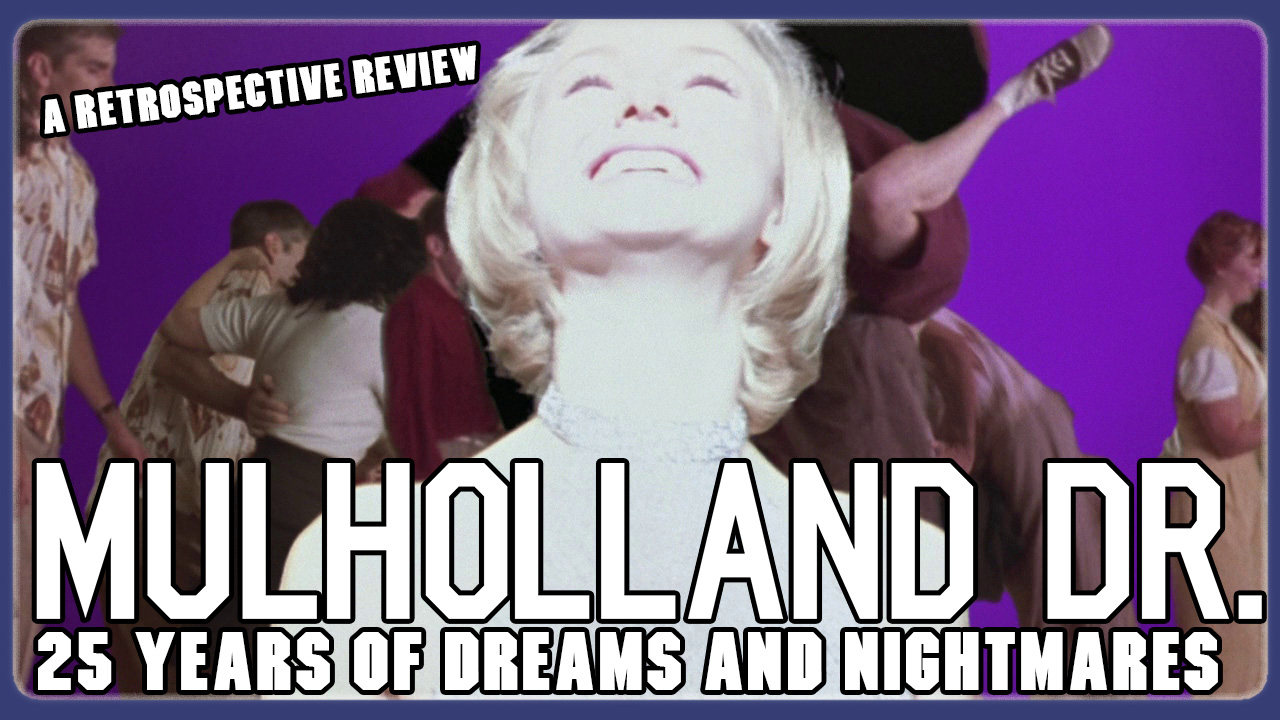
The film, on its own, launched the mainstream career of Naomi Watts, who at the time was struggling to make it in Hollywood. The dual reflection of Betty Elms and Diane Selwyn, both played by Naomi Watts, makes complete sense in Lynch’s twisted mind. Earlier in the film, Betty smiles uncontrollably as she leaves the airport with her family. The awkward overdubbing of the dialogue in that particular scene opens a box of dream logic, distant memories, and the uncanniness of what dreams are made of. Lynch was known for creating this feeling throughout nearly all of his films outside of The Straight Story. He was also known for his love of 1930s through 1950s iconography. Mulholland Drive literally opens with a nightmarish, distorted montage of couples dancing the jitterbug before the camera crashes into a pillow, descending the audience into a world that is broken but still filled with expressive dreams.

Betty’s (Naomi Watts) entire motive inside this warped dream is believing she’ll become a successful actress in Hollywood, and she’ll do whatever it takes to achieve that dream. Lynch understands this by opening the narrative with dream logic. Characters that may or may not exist inside Betty’s mind adopt different names for themselves. Camilla (Laura Harring) or Rita can be either one. It doesn’t matter. What matters is the essence of dreams. Hollywood dreams, in fact. The kind of Hollywood dreams that make a person feel jealous or guilty about their actions. Lynch has no definitive answer for what Mulholland Drive is trying to say about dreams, alternate realities, or the romanticism of Hollywood as a place where dreams come true. He won’t tell you because it would defeat the purpose of his art.
Sunset Boulevard has often been compared to this film because it deals with the jaded nature of Hollywood dreams through the revolutionary transition from silent films to talkies. However, Mulholland Drive feels like Lynch coming to terms with the ever-changing landscape of sacrificing art in Hollywood. His frustrations with the industry remain intact throughout the film, and they reveal themselves through its crime-noir aesthetics. One of the major plot points revolves around the emboldened jealousy between Betty and Rita. Adam Kesher (Justin Theroux), a hotshot director, is forced by the mob to cast Camilla, or Rita, depending on how you interpret the dream. The film’s intentional incoherence regarding the paths these characters take somehow intersects with Betty’s inability to break out in Hollywood. It is implied later in the film that Betty hired a professional hit-man to kill Rita out of jealousy after being rejected romantically. That jealousy feeds into the idea that Hollywood is a town built on competition and performance.
You could even argue that Naomi Watts is playing a version of herself since she struggled to land major roles early in her career. David Lynch brilliantly begins this process by luring the audience into Betty’s subconscious. Her dreams are supposed to be filled with love and lust. But outside the little blue box the film presents, there is nothing but hate. Hate over how Camilla, or Rita, has become the star Diane, or Betty, desperately wants to be. Hate over the way Hollywood treats women. This is highlighted most during the audition sequence, where Betty reaches out to become the best actor in the room. Naomi Watts radiates such tenacity in that scene that it almost feels too realistic to witness with your own two eyes.

Lynch’s masterpiece is wholeheartedly a film about fears and dreams. The manifested dreams of Diane and Betty eventually become reality as these fractured identities are left crying in the corner after their love has been destroyed. You could argue that they deserve to be cursed for what they did to themselves. But even then, you still relate to their pain. The balance between dreams and “the truth” is completely dependent on each other. It has to be that way or the film would collapse into self-gratification over Hollywood iconography. Lynch isn’t interested in romanticizing how the industry works. He exposes its most devilish qualities. His next film, Inland Empire, dives even deeper into the theme of broken Hollywood dreams. But it’s Mulholland Drive where he truly shines as both a director and storyteller. Lynch’s extreme attention to emotion, feelings of grandeur, and faded nostalgia all come together through the aching pain of being a tortured artist.
Emotions are not supposed to exist in a linear fashion. They come in waves and have an effect on everyone around you. When Lynch passed away in 2025, a burning light suddenly became nothing but smoke. Maybe it was the heavy cigarette smoking that followed him throughout his life. Or maybe it was the toxins that entered his immune system during the California wildfires. Even then, Lynch’s lasting effect on modern cinema is something to behold. Cinephiles like myself are deeply invested in Lynch’s filmography. Mulholland Drive being placed on countless lists as one of the greatest films of the 21st century is completely warranted.
Cinephiles want to become artists, and starving artists become infatuated with the dreams they set for themselves. It’s almost as if Lynch was speaking to a generation, or even a future generation, that wanted to become bigger than what they were. Lynch was never afraid to show the truest sides of himself through dreams and nightmares. He also wasn’t afraid to show humanity for what it really is. I think artists struggle early in their careers with understanding what they want to do with their art, and Lynch never seemed afraid of that because the fear was already displayed on the screen for all to bear witness. So, it makes complete sense that fans of this film continue to celebrate its legacy after Lynch’s death.
This film will truly stand the test of time through its millions of analytical essays and its newfound appreciation for Lynch’s beautiful affection for surrealism.