
(This is a recount of the past and the present. It entirely relates to the movie by the way)
“I honestly wish I knew how to really quit you” – Jack Twist (Brokeback Mountain) or Sombr (The Musician)

I remember having a feeling of existential joy when I came over to your house for a sleepover when I was in middle school. I wasn’t particularly the best of friends with your younger brother. However, I laid my eyes on you. Growing up in a southern, rural town while trying to figure out who you are is something to behold. There wasn’t much going on in the neighborhood. I can describe the neighborhood as a mixture of the TV show The O.C and the hit indie album The Suburbs by Arcade Fire. The post-recklessness of the financial housing crisis and endless wars in the Middle East somehow were juxtaposed by how I was acting out as a teenager. I was fully aware of the consequences of massive, financial debt and collapsed hearts of the under-served communities in middle-class households. My family was close to being torn by the 08 financial crisis, and the only way to survive was to turn to the word of God.
God, at an early age, was supposed to be a halo and a beacon for hope, just like Superman. But turning to his words at a time of being in the closest was somehow frightening to me. I jumbled between two factions: one that was before the Old Testament (Judaism) and one that preached afterward (Catholicism). Both are cut from the same cloth if we really dig deep. But the same connotations of “sinful” homosexuality are intact with both sides of the coin. My eyes darted away from these scriptures and went straight into the closet. So when I laid eyes on someone who was slightly older than me, it felt like a heavenly way to die. Just like The Smiths or Troye Sivan say in their respective songs.
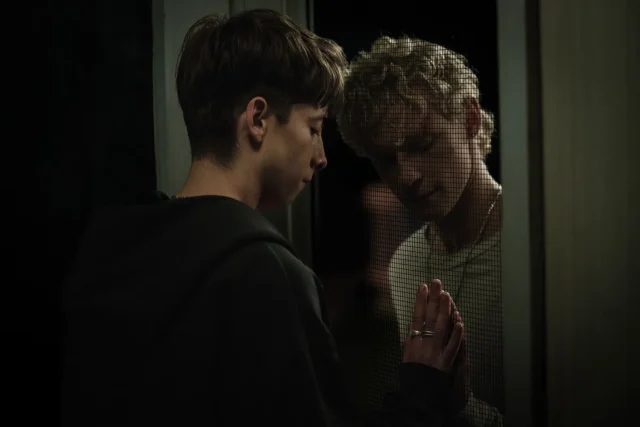
In Adrian Chiarella’s Leviticus, two Queer boys are trapped in their own bodies as a demon possesses them and tries to let them sort it out with the devil. Naim (Joe Bird) affectionately pulls out the stops for Ryan (Stacey Clausen), a jock who seems to be the gateway to every boy’s heart in the oil-infested town of Victoria, Australia. Just like any other rural town in the world, religion is the only place for community, and Naim is forced into religion by assimilation from his mother, Arlene (Mia Wasikowska). A coldness brews between Naim and his mother, which slowly rots once Naim is pressured to stay in the ultra-conservative religious community in order to “save himself.”

A major theme of the film is the avenues through which queer people have to deal with when trying to hide their identity. Naim, in the beginning, yearns for Ryan and latches onto the puppy love because that is all that he has in his life. Circling back to my upbringing, I completely relate to Naim, especially back then, when my closet was already shut close because of the unbearable weight of my gaping heart. I had no place to go. I had no place to turn to. God felt like a lie, so I had to rebel. It burns in my chest to know that I could’ve left the town if I had the chance. But I was just too scared to let things go.
So that night, when I went over to your little brother’s house for a sleepover, it wasn’t necessarily about the sleepover; it was about getting to know you as a person. And I did. We had the time of our lives as two prepubescent boys, yearning for each other. The sentimentality and drowning of romance are displayed quite elegantly throughout this film. It felt like a ripped page from my journal in some ways. Chiarella, despite conforming to the modern horror tropes, has really found a nice balance of personality through the closed, tight arms of two queer characters. They never leave the sight of the viewer, even when shit goes down.
The allegorical and supernatural elements of the Leviticus Bible verse are implied through Naim and Ryan’s circling battles with coming out as a queer person in an unaffectionate world. The way demonic possessions function for both characters remains inconsistent and unclear through this film. But the intention is there despite the shortcomings of the screenplay. Joe Bird perfectly plays the wide-eyed twink (complementary) who wants the relationship to succeed but is constantly being chased by unforeseeable obstacles that are invisible to the eyes and ears of the Lord. Stacey Clausen uses Ryan as the instigator who doesn’t understand that he’s hurting other people around him. Arlene (Mia Wasikowska) is unfortunately written with a thick-skinned attitude and coldness toward Naim. A mother who names her child Naim (Name) should be banished straight to hell, as her motherly instincts are written with such brashness to the audience’s hearts. Her character is almost laughable at some points, and it really throws Naim into a perspective of sympathy or empathy.
And that’s certainly the entire point of the film as a whole. Organized, performative religion unfortunately rots the brains of the young. Younger queer people who still follow religion might ask the question,
“Is it worth it to continue to study the words of the Lord, even if the words don’t add up to the common good of humanity?”
And to that I say, maybe. Someone’s journey with the scriptures of the Lord depends on how much they’ve lived a life of a lie or not. Your true self blooms long after you leave your hometown, and it truly did for me. I’m still thinking about that boy who opened my heart into a million pieces and was able to precisely identify and put those pieces back together through kind words and affectionate telepathy.
Because, that’s what we all need in this lifetime. Of course, I did quit you long after we left our bodies and homes. But, it wasn’t intentional. It was just a part of life.
Rating: 3.5/5